The Capture Issue #001
The beginning of a new industry

We are House of Moves, one of the oldest motion capture and animation studios in all the land. We have been quietly hand-animating and providing motion capture for film, TV and AAA content for nearly 30 years.
TALES FROM THE TRENCHES
House of Moves was founded in the 1990s specifically to produce motion capture (mocap) for James Cameron’s Titanic (1997), creating lifelike digital people and background characters that populated the ship’s decks—one of the earliest major uses of mocap in film. From there, the LA-based studio quickly became a leader in capturing authentic performances via marker-suited actors, powering AAA games, Hollywood blockbusters, commercials, and experimental VR/dance projects. House of Moves evolved into a full-service animation powerhouse, embracing hybrid pipelines, markerless capture, virtual production, LED volumes, and AI tools—solidifying its legacy in turning mocap from an experimental gimmick into essential storytelling magic for indie and blockbuster work alike. Check out this featurette. It has some great behind the scenes shots of Titanic motion capture.
NEW TECH
Markerless Motion Capture: Markerless motion capture is a technology that tracks an actor’s body and facial movements using only cameras and AI-powered computer vision — no suits, no reflective markers, and quick to setup. In recent years, markerless systems have advanced rapidly. Leading solutions from Vicon, Move AI, OptiTrack, and others now deliver real-time tracking, great performer freedom, and fast iterative workflows. This has made them popular for pre-visualization, indie games, virtual production, and rapid prototyping in both film and game development. However, while markerless technology has come a long way, it is not yet ready to fully replace traditional marker-based systems. For big-budget movies and major game titles, studios still rely on marker-based optical capture for its superior precision — especially for complex full performance captures, props, environments and occlusion-heavy scenes. Markerless data often requires significantly more manual cleanup to reach final cinematic or gameplay quality. We were recently sent some markerless data to clean up, and due to the high and low frequency jitters, the data became very time consuming to clean up (which sort of defeats the purpose of its quick and easy format). So while it’s not there yet, we believe it has the potential to be a major player. In the (near?) future we’ll long for the days of searching for missing markers and unflattering spandex.
PIPELINE HIGHLIGHT
Retargeting:
Retargeting is when you take the actor-derived skeleton and have it drive (or control) the game/movie character. Ideally, whatever the actor did on stage the assigned character will do too. Easy-peasy right? Well, not so fast. There are a lot of things to take inconsideration, starting with how big your character is compared to the actor who performed the motion. Preferably, the character and actor would be the same height and have the same bone lengths (we call that 1-to-1), but that’s almost never the case. Characters are designed to evoke emotion and convey a message at first glance, starting with how big your character is compared to the actor who performed the motion. These size discrepancies between actor and character can make transferring the motion more difficult, especially when you add in props and environments that were measured and blocked out on stage. Interactions need to match up no matter the size differences.
Luckily for us, we’re used to seeing these types of challenges and have been solving them for years. By using the different “character retargeting” options in MotionBuilder, we make adjustments, keying them on and off as needed. We use a series of our own tools and constraints to get through the bulk of the work quickly before we move on to baking everything down to the character’s own control rig. During this stage we use the synced video reference (shot on stage during the performance capture) and make sure silhouette, eyeline, posture, and mesh intersections are all taken care of. We also clean up all foot contacts and adjust every prop and environment interaction. We then bake it down to the character’s skeleton and get it ready for delivery and animation.
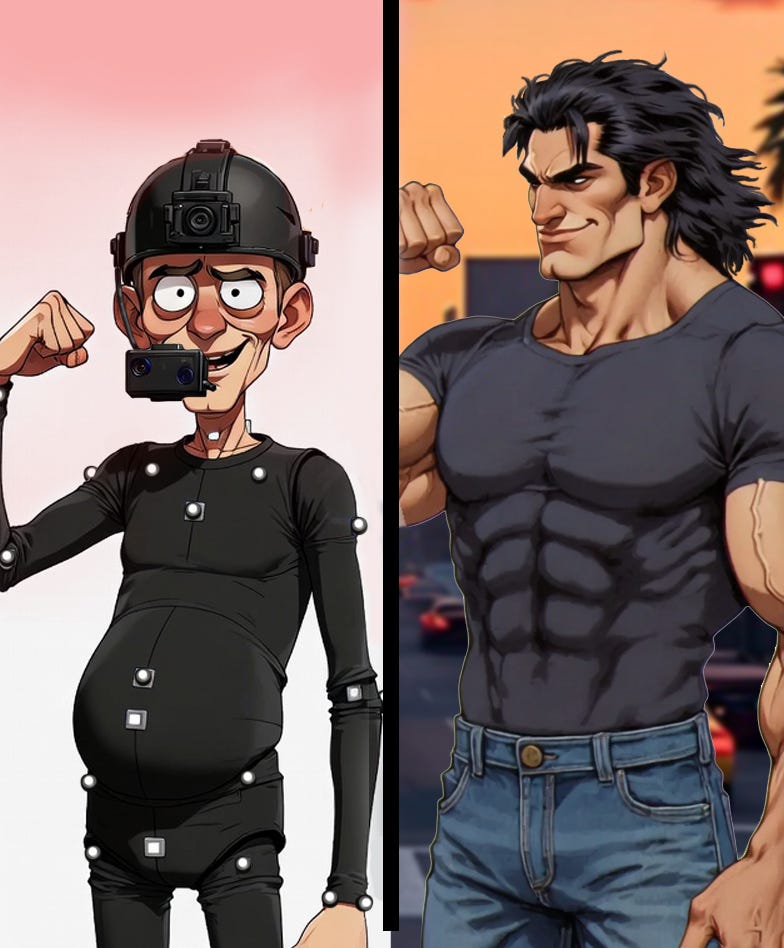
In summary: For quick and easy retargeting, it’s always best to keep actors and characters as close to the same size as possible (though it’s not necessary). Measured props and environments, plus multi-character grappling or interactions, add difficulty. There are different levels of retarget quality. It’s always best to prepare characters and cast actors with the help of the motion capture provider.
THOUGHTS ON THE INDUSTRY
The industry is rough right now. Studios big and small are laying off large portions of their workforce (45,000+ jobs from 2022 to mid-2025). AAA video game production is down roughly 20–40% from 2021. Theatrical movie production is down 15–30% from 2019, while overall film/TV production (heavily influenced by streaming) saw 20–40% drops in recent years due to strikes, cost-cutting, and a shift away from volume-based streaming slates. Then there’s the growing fear and realization that AI is going to take all the creative jobs.
The concern is real… and we’re affected by all of it as well. We saw this coming and pivoted early: smaller, more streamlined teams and pipelines, three additional motion capture stages (four in total), and a recalibrated focus on higher quality and faster delivery. We’ve even opened our doors to co-development.
AI is a big scary beast, but right now it’s also a tool that can be sharpened and pointed at problems. What used to take months now takes a few moments. Our perspective is optimistic. It wasn’t that long ago when people said motion capture was going to kill animation. Instead, it opened more doors for animators—and keyframe animation thrived.
Next issue: Ranking the animation software we use, industry spotlight, and more..